Does Xtracto connect to my bank?
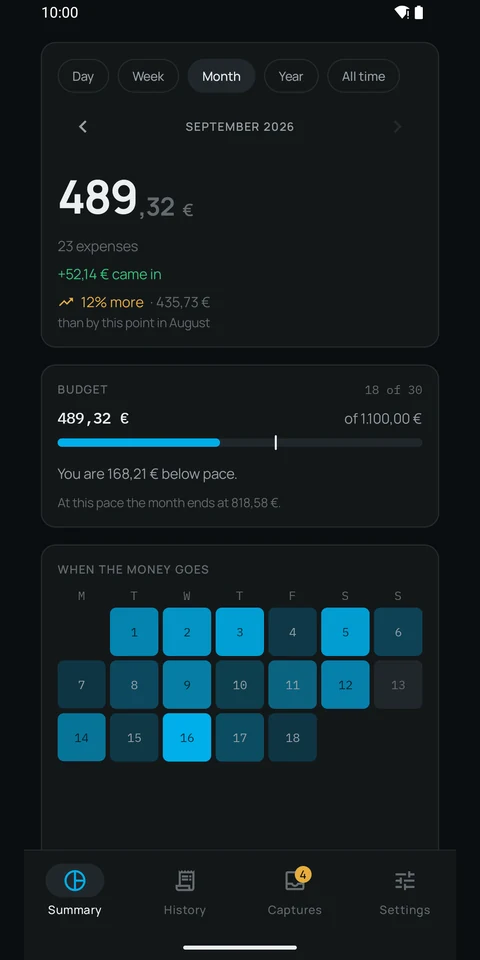
No. It does not ask for your credentials, it does not use Open Banking, and it cannot read your real balance or move money. It only reads the alerts your bank already sends to your phone and turns them into transactions.
Does it need an internet connection?
No, and it cannot have one: the app declares no INTERNET permission. It works entirely offline, and even if it wanted to send your data to a server the operating system would stop it. That is not a promise, it is a technical limitation you can verify yourself on the installed file.
Is it safe to grant notification access?
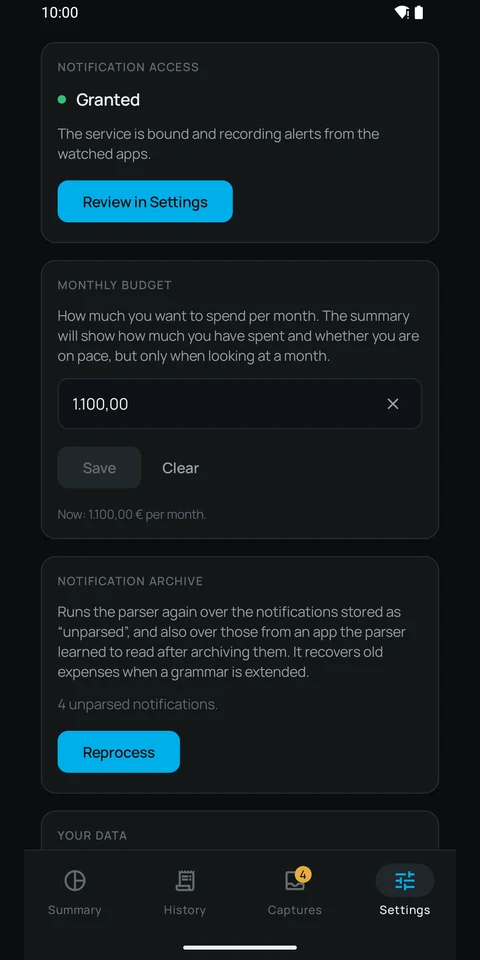
It is the most sensitive permission the app asks for and it deserves an honest answer. With it, Android lets Xtracto see the notifications that arrive on your phone. Xtracto only looks at those from a closed catalogue of 216 finance applications, and within that catalogue you decide one by one which ones it listens to, under Settings. Switching one off is not hiding it: the service does not even open its notifications. It reads and stores nothing from the rest of the phone, so your messages, your email and your social networks are discarded untouched. And because the app cannot reach the internet, what it reads has nowhere to go. You can revoke the permission whenever you want from Android settings.
Where is my spending data stored?
On your phone, in a local database no other application can open. It is not uploaded to cloud backup, you can export it to CSV whenever you want, and uninstalling deletes it completely, because there is no copy anywhere else.
Which banks does it recognise?
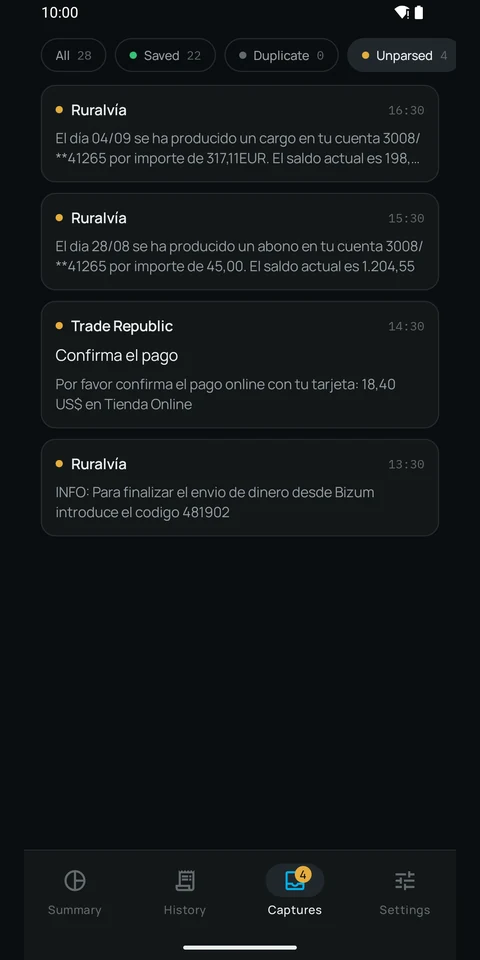
A specific set of banks, which grows with the formats people send in. If yours is not there, the app will tell you: it stores the alert without interpreting it and you can send us the message template without sending us any of your data, because it replaces amounts, dates, merchants and numbers with placeholders first.
Can I enter an expense by hand?
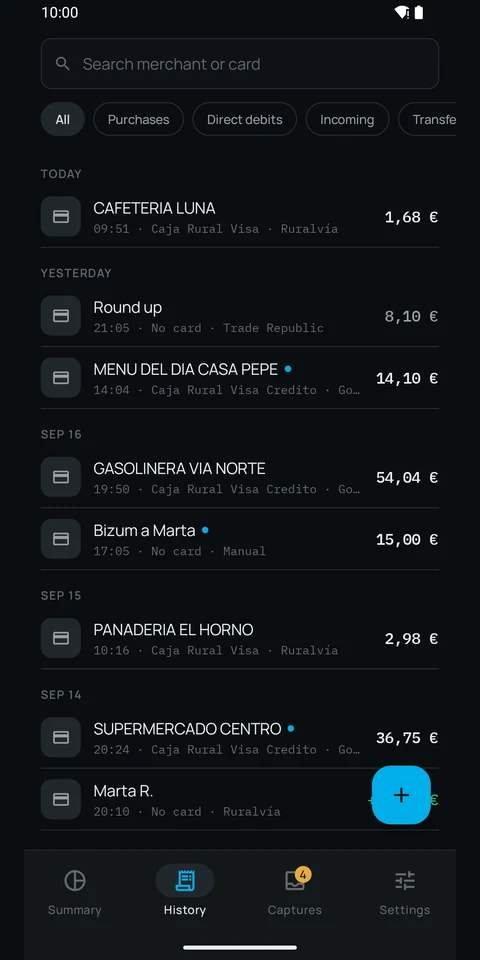
Yes. There is a button to enter by hand whatever no app announces —a payment you sent to a friend, a cash purchase—: the amount, who it went to and the date. If the bank alert for that same amount arrives within the next three days, it replaces your entry instead of duplicating it. It is also how you keep track of your spending while your bank is not recognised yet.
Is there an iPhone version?
No, and for now there cannot be: iOS does not let an application read other apps’ notifications, which is exactly what Xtracto lives on. It is a limitation of the system, not a decision of ours.
When will it be available to download?
It is already on Google Play, but in closed testing: today only accounts enrolled as testers can install it. Before it can be published for everyone, Google requires 12 people to be in the test for 14 days in a row and to actually use it; as soon as that is done, it ships. If you want in, you can ask on the closed test page.
 Xtracto